Tag: BMW

IS DEE THE FUTURE OF BMW?

IS DEE THE FUTURE OF BMW?

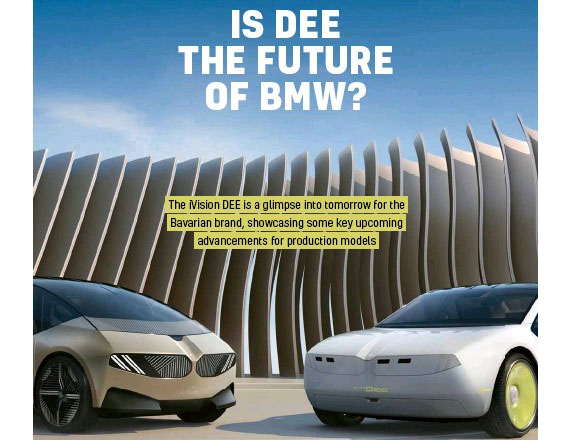
The ivision DEE is a glimpse into tomorrow for the Bavarian brand, showcasing some key upcoming advancements for production models

BMW has recently developed a knack for dropping jaws. Whether it’s the kidney grille on the M4 or the altogether squared-off XM, everyone has something to say about the brand. And the new ivision DEE is no exception.

Read : Tesla’s excellence is still proving the doubters wrong

This concept’s uncluttered three-box design reminds us of the E30 sedans of yore, but brought into the age of EVS. It doesn’t even look like a BMW from right ahead in all-white because the kidney grille can colour shift. Those, along with the headlamps, will change to produce different facial expressions to convey moods such as “joy, astonishment or approval”.

Read : EV popularity approaches global tipping point

The ivision features the German firm’s upcoming Neue Klasse electric car platform, and these dedicated underpinnings mark a departure from trying to adapt a car designed to use an internal combustion engine as the automaker starts building EVS from the ground up.

Read: Washington County Invests in Electric Vehicle Charging Infrastructure

The big news is the inclusion of a virtual assistant, much like Amazon’s Alexa or Apple’s Siri, but because it’s a car talking back to you, not a phone, most people will find it easy to imagine something akin to KITT of Knight Rider fame. The blank white bodywork is also a canvas of sorts, being made up of 240 E-ink segments, which is a technology that can use up to 32 different colours, so the entire exterior of an ivision DEE could be completely customised.
BMW, The Ultimate Driving Machine Is Making News With Alternative Transportation

BMW, The Ultimate Driving Machine Is Making News With Alternative Transportation

At the 1972 Olympic Games in Munich, BMW used two cars, modified to “run silent, run electric” (almost a pun) — to accompany long distance runners, and for other official duties.

The cars were of the 1602 model range, and the 350 kg lead-acid batteries were loaded under the hood on a skid to allow for a fast change after some 50 km.

You must have often wondered how the bicyclists or marathon runners could NOT be affected by the exhaust fumes of the cars or motorbikes filming them at close range, and why this idea had not come up earlier.

One of the people in charge at BMW must have been an athlete, or at least considerate enough to give the Olympians a “breather”.

The R&D people took a breather as well, until they modified a 3-series car in 1982.

The battery this time was a sodium-sulphur type that “only” weighed 265 kg. With three times the energy density (an important term in alternative transportation), the eight E30 325iX test vehicles so equipped could run about 150 km in city traffic.

While all BMWs to this time were rear-wheel-drive, these cars were modified to front-wheel-drive.

Management was encouraged by the results, and continued to pursue the idea of a purely electric car. In auto shows during 1991 the company showed a concept of their idea of a city car, the E1.

Lithium-Ion batteries are the new way to power most things now, and the BMW-owned Mini was powered by these new energy storage devices in a 600 strong test fleet in 2008. Select customers in North America and Europe are driving the Mini E, while the company monitors the cars behavior during daily driving chores.

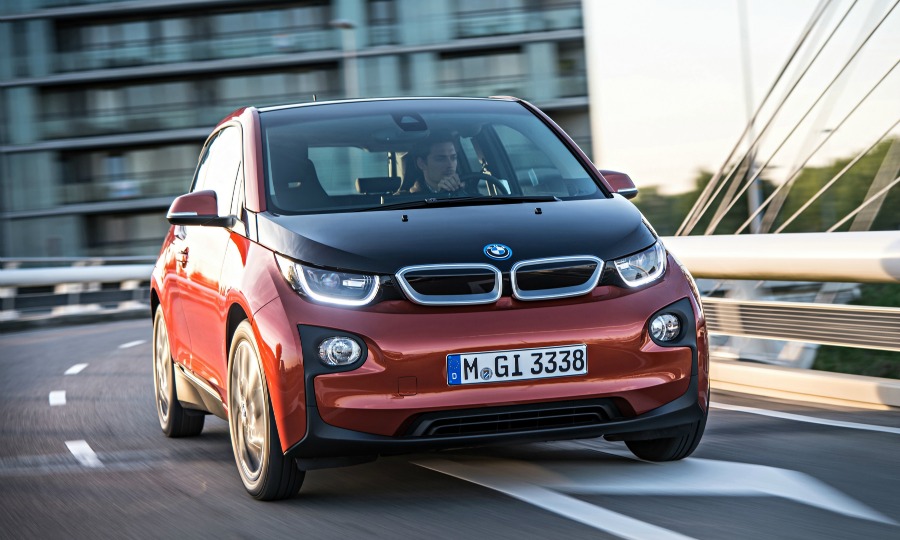
The smallest BMW at this time is the 1-series, and based on that, the Bavarian carmaker has produced a fleet of 1000 i3, purely electric lightweight EVs. BMW started selling these in 2011, and their green-oriented owners are gathering information for other future electric cars.

In 2013 BMW and Toyota announced collaboration on developing electric drive-trains and light-weight carbon fiber body structures together. An electric sportscar, dubbed i8, is in the planning stage.